AI Detector vs. Plagiarism Checker: What Each Tool Actually Checks
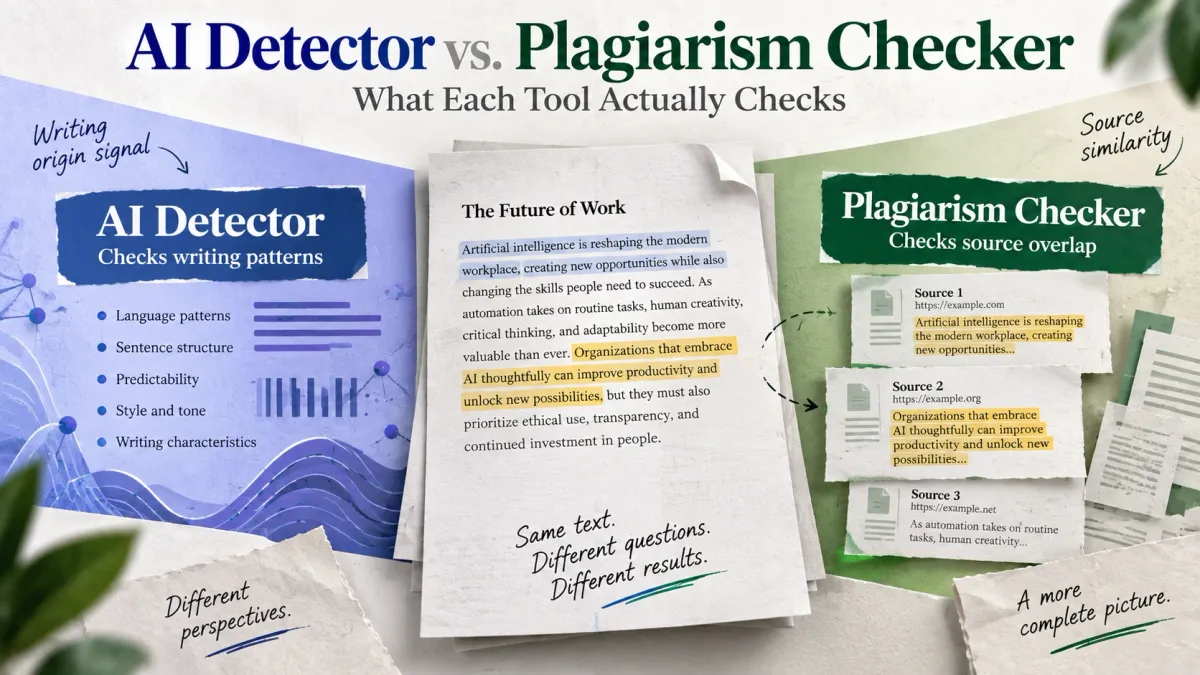
AI detectors and plagiarism checkers both analyze written content, but they answer fundamentally different questions. An AI detector evaluates whether text shows patterns associated with AI-generated writing, while a plagiarism checker compares text against available sources to identify matching or similar passages.
Understanding the difference helps editors, marketers, and content teams choose the right check when reviewing professional documents or AI-assisted drafts.
A document can be AI-generated and contain no detectable source matches. Similarly, human-written content can have a high similarity score because it includes quotations, references, or reused wording.
Neither tool can reliably answer both questions on its own.
AI Detector vs. Plagiarism Checker: Quick Answer
An AI detector estimates whether text resembles AI-generated writing. A plagiarism checker identifies similarities between submitted text and existing sources.
The primary difference is what each tool measures:
- AI detection: Looks for characteristics associated with machine-generated writing.
- Plagiarism checking: Identifies text that matches or closely resembles material in available sources.
An AI-detection score does not establish whether content was copied. Likewise, a similarity score does not establish whether a human or an AI system wrote the text.
If you need to evaluate both possible AI use and source originality, you may need both checks.
AI Detector vs. Plagiarism Checker: Key Differences
| Feature | AI Detector | Plagiarism Checker |
|---|---|---|
| Main purpose | Estimate whether writing resembles AI-generated text | Identify text matching available sources |
| What it analyzes | Linguistic patterns and classification signals | Matching or similar passages |
| Requires matching sources? | No | Yes, to report a source match |
| Typical result | AI-related classification, estimate, or score | Similarity score and matched passages or sources |
| Can identify copied text? | Not reliably | Identifies matching passages in available sources; context is needed to assess plagiarism. |
| Can identify possible AI writing? | Yes, with limitations | Not through source matching alone |
| Main limitation | False positives, false negatives, and model variation | Limited source coverage and contextual interpretation |
| Proves misconduct? | No | No |
The simplest distinction is that AI detection concerns possible writing origin, while plagiarism checking concerns source overlap.
These are separate characteristics of a document, and they should be evaluated independently.
What Is an AI Detector, and What Does It Check?
An AI detector is a text-analysis system designed to estimate whether writing resembles content generated by a language model.
Instead of searching for copied material, AI-detection systems evaluate characteristics of the submitted text.
Depending on the technology, those characteristics may include:
- Word and phrase predictability
- Sentence structure and variation
- Linguistic patterns
- Statistical representations of writing
- Features learned from human-written and AI-generated examples
Many modern detectors use machine-learning classifiers. Their underlying methods differ, so two tools may produce different results for the same passage.
An AI detector might label a document as likely AI-generated, likely human-written, mixed, or uncertain. Some detectors also provide percentage-based scores.
However, an AI-detection percentage does not automatically represent the exact percentage of words written by AI. Its meaning depends on the tool's scoring methodology.
An AI detector also cannot reconstruct the complete writing process merely by examining the final text.
Research published in the International Journal for Educational Integrity has documented classification errors and inconsistent performance across AI-detection systems. These limitations are especially important when results influence academic or professional decisions.
For a more technical explanation of classification methods and scoring, read How AI Detectors Work: Scores, Signals, Limits, and Responsible Use.
For a closer look at classification methods and score interpretation, read how AI detectors work.
What Is a Plagiarism Checker, and What Does It Check?
A plagiarism checker is designed to identify text that matches or resembles existing material in sources available to its comparison system.
A typical plagiarism-checking workflow involves:
- Analyzing the submitted document.
- Comparing its text against accessible sources.
- Identifying matching or similar passages.
- Presenting the results in a similarity report.
The report may identify matching passages, source locations, and an overall similarity percentage.
HumanizeAI's plagiarism checker is designed to help users examine textual overlap and review corresponding sources.
However, finding matching text is not the same as proving plagiarism.
A document may contain matches because of legitimate quotations, properly cited material, standard terminology, or commonly used expressions.
For example, a research paper could quote a published study accurately and provide the correct citation. A similarity checker might still identify the quoted passage because its wording matches the original publication.
That does not automatically make the quotation plagiarism.
Turnitin's guidance on similarity reports makes the distinction clear: similarity reports identify text matches, while determining whether plagiarism occurred requires human judgment.
A similarity score measures detected source overlap, not academic dishonesty or authorship.
Can AI-Generated Content Pass a Plagiarism Check?
Yes. AI-generated content can receive a low similarity score when its wording does not closely match sources available to a plagiarism checker.
This happens because AI generation and source matching evaluate different properties of written content.
Consider an illustrative situation:
A writer asks an AI system to explain a familiar scientific concept. The system generates several paragraphs using wording that does not closely match any source accessible to the plagiarism checker.
The document might produce:
- A high AI-related classification from an AI detector.
- A low similarity score from a plagiarism checker.
These results would not contradict each other.
The first analyzes characteristics associated with AI-generated writing. The second analyzes matches with existing material.
Importantly, low similarity does not guarantee originality in the broader sense. A document may contain unattributed ideas, inaccurate claims, or other issues that a source-matching system cannot identify.
Passing a plagiarism check does not prove that content was written by a human.
Can Human-Written Content Have a High Similarity Score?
Yes. Human-written material can produce a high similarity score without necessarily involving improper copying.
Common reasons include:
- Correctly quoted passages
- Bibliographies and references
- Standard definitions
- Common technical terminology
- Reused templates
- Material appropriately cited from published sources
For example, imagine a student writing an assignment about copyright law.
The student includes several accurately quoted legal definitions and cites the original sources.
A plagiarism checker may identify these passages as matches even though the student has followed the applicable citation requirements.
The correct response is to inspect the matching passages and determine whether they have been used appropriately.
A high similarity score alone cannot establish plagiarism.
Conversely, a very low similarity score cannot establish that the document has met every attribution or academic-integrity requirement.
Can a Plagiarism Checker Detect ChatGPT or Other AI-Generated Text?
A conventional plagiarism checker cannot reliably identify ChatGPT authorship through source matching alone.
Its primary function is to compare submitted text against existing material.
If ChatGPT produces wording that substantially matches an accessible publication, a plagiarism checker may identify that match.
However, the match itself does not reveal whether the text was produced by ChatGPT, copied by a human, or written through another process.
Some writing platforms provide both AI detection and plagiarism checking in one interface. That does not make the underlying analyses equivalent.
A combined platform may return two separate reports, each addressing a different question.
If your question specifically concerns possible ChatGPT authorship, read our detailed guide on whether ChatGPT-generated content can be detected.
Can an AI Detector Detect Plagiarism?
Not as a reliable replacement for a plagiarism checker.
An AI detector evaluates writing characteristics rather than systematically comparing the submitted document against external sources.
Imagine someone copies several paragraphs from a human-written article.
Because the copied paragraphs originated from human-written material, an AI detector might classify them as human-like.
But a plagiarism checker could identify the copied passages if the original source is available to its matching system.
This illustrates why an AI detector cannot establish source originality.
Similarly, plagiarism-checking results cannot reliably establish whether writing was generated by AI.
To evaluate both concerns, use the appropriate checks separately.
AI Detection Score vs. Plagiarism Similarity Score
AI-detection scores and plagiarism similarity scores are frequently misunderstood because both may be displayed as percentages.
However, the percentages do not measure the same thing.
Suppose a document receives the following hypothetical results:
- AI-related score: 70%
- Similarity score: 8%
The 70% result must be interpreted according to the AI detector's documented scoring method. It might represent a classification estimate, a portion of text flagged, or another model-specific measure.
The 8% similarity result describes qualifying textual overlap found by the source-comparison system under its settings.
These percentages should not be added, averaged, or directly compared.
A document may have a high AI score and low similarity, or a low AI score and high similarity.
Four Examples of Possible Results
| Scenario | Possible AI Detection Result | Possible Similarity Result | What It Means |
|---|---|---|---|
| AI-generated passage with little identifiable source overlap | High | Low | The text may resemble AI writing without matching available sources |
| Human-written document with extensive quotations | Low | High | Source matches may reflect legitimate citations |
| Human-written original essay | Low | Low | Neither check raises a strong signal, but neither proves authorship or full originality |
| AI-generated passage containing copied source material | High | High | Both AI-like patterns and source matches may require review |
These scenarios are illustrative, not predictions of what every detector will report.
The key principle: An AI score is not a plagiarism score, and a similarity score is not an AI-authorship score.
When Should You Use an AI Detector?
Use an AI detector when your main concern is whether writing exhibits characteristics associated with AI-generated content.
It may be useful when:
- Reviewing an AI-assisted draft
- Understanding how a text is classified by an AI-detection system
- Investigating possible AI involvement alongside other evidence
- Supporting editorial quality-control workflows
- Reviewing content under an organization's AI-use policy
For example, an editor may use an AI detector as one preliminary signal while evaluating a submitted article.
However, the editor should also check factual accuracy, citations, originality, writing quality, and any relevant disclosure requirements.
If an AI detector flags a passage, the result should prompt further investigation rather than an immediate conclusion about authorship.
You can use HumanizeAI's AI Detector to examine possible AI-writing signals.
When Should You Use a Plagiarism Checker?
Use a plagiarism checker when your main concern involves source overlap, attribution, or reused wording.
Typical questions include:
- Does this passage match an existing publication?
- Have I accidentally reused wording from a source?
- Are quotations and references properly attributed?
- Does an article contain passages matching previously published material?
- Which sources correspond to the detected matches?
For students, plagiarism checking can support citation review before submission.
For editors, it can help identify passages that require further investigation or attribution.
For professional writers, it can reveal unintended similarities that may need to be addressed.
The important step is to review the matches themselves.
A similarity percentage without source context provides an incomplete picture.
Should You Use Both an AI Detector and a Plagiarism Checker?
Use both when you need to answer two independent questions:
- Does the document contain text matching existing sources?
- Does the document exhibit patterns associated with AI-generated writing?
For example, an editorial team reviewing an external submission may need to evaluate both possible AI use and whether the writer has attributed borrowed material appropriately.
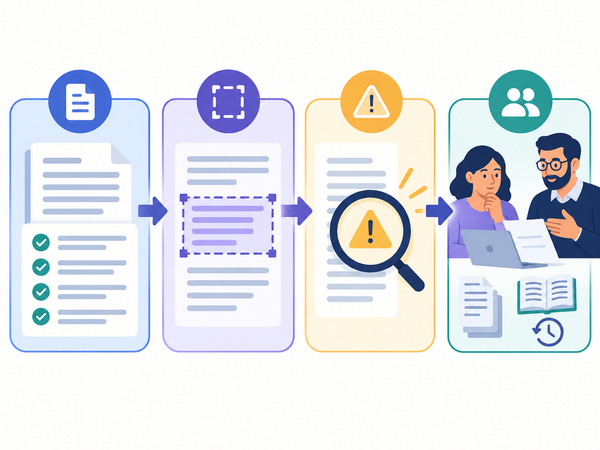
A practical review process can combine the two tools without treating either result as conclusive.
Step 1: Identify What You Need to Verify
Start with your actual concern.
If you want to investigate source overlap, choose plagiarism checking.
If you want to evaluate possible AI-generated writing, choose AI detection.
If both questions are relevant, plan to review both types of evidence.
Step 2: Run the Appropriate Check
Submit the document using the selected tool and follow its instructions.
Avoid making important decisions based on a very short passage or a score without context.
Step 3: Examine the Results
For plagiarism checking, inspect the matched passages and associated sources.
For AI detection, review the classification, the tool's score definition, and any highlighted sections.
Step 4: Investigate Unexpected Findings
If a passage has a high similarity score, determine whether the match involves a legitimate quotation, correctly attributed material, or problematic reuse.
If human-written text is flagged as AI-generated, examine the writing history, drafts, notes, and other available evidence.
Step 5: Review the Document as a Whole
Evaluate factual accuracy, source quality, citations, writing clarity, and compliance with relevant policies.
Neither tool can replace this broader editorial assessment.
Step 6: Make a Contextual Decision
Interpret both reports independently.
Where a decision could affect someone's education, employment, reputation, or publication, a fair review process is essential.
What Are the Limitations of AI Detection?
AI-detection systems can make classification errors.
A false positive occurs when human-written text is classified as AI-generated.
A false negative occurs when AI-generated text is classified as human-written.
Detection performance can vary according to the model, writing style, language, subject, document length, and editing process.
A 2026 study published in the International Journal for Educational Integrity evaluated commercial AI detectors using human, AI-generated, and hybrid writing. The researchers reported substantial limitations, particularly when classifying mixed-authorship texts.
Other research has documented differences between AI detectors and raised concerns about false positives.
These limitations are especially important when evaluating academic submissions or other consequential documents.
If human-written work receives an unexpected AI classification, read our guide to AI detector false positives and how to respond.
An AI-detection result should support a review process, not replace one.
What Are the Limitations of Plagiarism Checking?
Plagiarism-checking systems also have limitations.
First, they depend on the sources available to their comparison systems.
A document might contain unattributed material that is absent from the system's accessible databases.
Second, matching text does not automatically mean improper copying occurred.
The system may identify a quotation, standard phrase, bibliography entry, or legitimately reused passage.
Third, source similarity does not necessarily capture every form of plagiarism.
A writer might improperly use another author's ideas without closely reproducing the original wording.
That type of issue may require careful human assessment even when similarity is low.
As Turnitin explains, there is no universal similarity percentage that automatically establishes whether plagiarism has occurred.
The appropriate interpretation depends on the document and its context.
Which Tool Should You Choose?
The best tool depends on the question you need answered.
| Your Goal | Recommended Tool |
|---|---|
| Determine whether text resembles AI-generated writing | AI Detector |
| Identify potentially copied or matching passages | Plagiarism Checker |
| Review quotations and source attribution | Plagiarism Checker, followed by manual review |
| Investigate possible AI use in an academic document | AI Detector alongside other evidence and institutional policy |
| Review both AI-writing signals and textual overlap | Both tools |
| Prove authorship or misconduct conclusively | Neither tool alone |
If your primary concern is AI-generated writing, begin with an AI detector.
If your primary concern is matching or reused content, begin with a plagiarism checker.
If both concerns matter, use the tools together while interpreting their findings separately.
Frequently Asked Questions
What is the main difference between an AI detector and a plagiarism checker?
An AI detector estimates whether writing resembles AI-generated content. A plagiarism checker identifies text that matches or resembles existing material in available sources. They analyze different properties of a document.
Is AI-generated content automatically plagiarism?
No. AI-generated writing is not automatically plagiarism. Whether its use is acceptable depends on source attribution, applicable policies, the writing process, and how the content is presented. AI-generated content can still contain copied material or unattributed ideas.
Can AI-generated content have 0% similarity?
Yes. A plagiarism checker may report 0% similarity when it finds no qualifying matches under its configured conditions. That result does not establish human authorship, factual accuracy, or complete originality.
Can a plagiarism checker detect ChatGPT?
A conventional plagiarism checker can identify matching text within ChatGPT-generated content, but source matching alone cannot establish that ChatGPT produced the passage.
Can an AI detector identify copied content?
Not reliably. AI detectors classify writing characteristics rather than systematically searching for matching sources. A plagiarism checker is more appropriate for investigating copied or reused passages.
Can human-written text be flagged as AI?
Yes. False positives occur when human-written text is incorrectly classified as AI-generated. Research has documented such errors, which is why AI-detection scores should be interpreted with contextual evidence.
Is a high similarity score always plagiarism?
No. High similarity can result from properly cited quotations, references, templates, or other legitimate matches. The underlying passages must be reviewed to determine whether attribution and reuse are appropriate.
Can Turnitin check both AI-generated writing and plagiarism?
Turnitin offers similarity analysis and AI-writing detection capabilities in supported products and workflows. These analyses are distinct: the Similarity Report identifies textual matches, while AI-writing detection evaluates possible AI-generated content. Neither result should be treated as definitive proof of misconduct.
Do I need both an AI detector and a plagiarism checker?
Use both when source overlap and possible AI involvement are separately relevant to your review. If you only need to answer one of those questions, use the tool designed for that purpose.
Final Verdict: AI Detection and Plagiarism Checking Are Not the Same
AI detectors and plagiarism checkers serve complementary purposes.
An AI detector estimates whether text resembles AI-generated writing, while a plagiarism checker identifies similarities with existing sources.
Neither tool can independently prove authorship, originality, or misconduct.
The most reliable approach is to choose the tool that matches your question, examine the underlying results, verify sources when relevant, and apply informed human judgment.
When both AI use and source overlap matter, using both checks can provide a broader assessment—provided the results are interpreted separately.
Sources and Further Reading
- HumanizeAI — AI Detector: Product information and AI-detection workflow.
- HumanizeAI — Plagiarism Checker: Source matching and similarity-review features.
- Turnitin — Does Turnitin Check for Plagiarism?: Explanation of similarity reports and their interpretation.
- Weber-Wulff et al. (2023) — Testing of Detection Tools for AI-Generated Text: Research on AI-detection accuracy and limitations.
- Hadra, Cambridge & Mesbah (2026) — Evaluating the Accuracy and Reliability of AI Content Detectors in Academic Contexts: Research examining detector performance across different writing categories.
- Angelier (2026) — The Pitfalls of AI Detection in Academic Writing: Review of bias, false positives, and responsible evaluation.