10 Best AI Search Visibility Tools in 2026: Tracking Platforms Compared

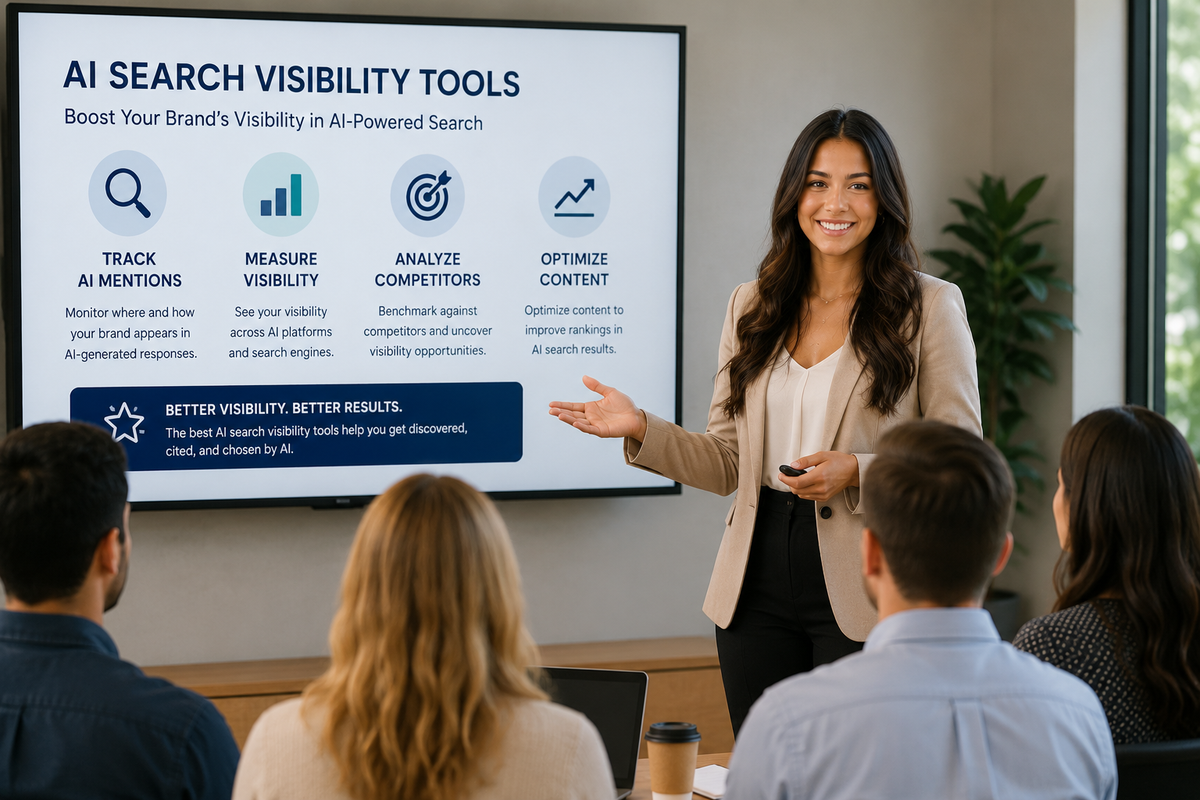
AI search visibility tools show whether your brand appears, gets cited, or is recommended in AI-generated answers across ChatGPT, Google AI Overviews and AI Mode, Gemini, Perplexity, Microsoft Copilot, and other answer engines.
Unlike traditional rank trackers, these platforms measure signals such as AI mentions, citations, prompt coverage, competitor share of voice, sentiment, and the sources AI systems use when generating answers.
The best AI search visibility tool depends on what you need to measure. Some platforms specialize in prompt-level monitoring. Others combine tracking with traditional SEO, content optimization, competitor research, or revenue attribution.
If you're still building your overall strategy rather than choosing software, start with our Google AI Search optimization guide to understand how SEO, AEO, GEO, citations, entities, and AI visibility fit together.
For this comparison, we reviewed 10 leading platforms based on their AI-engine coverage, prompt tracking, citation analysis, competitor monitoring, pricing transparency, optimization capabilities, and ideal use case.
Best AI Search Visibility Tools at a Glance
| Tool | Best For | Key Strength | Starting Price* |
|---|---|---|---|
| Profound | Dedicated AI visibility analytics | Deep answer-engine analysis and daily prompt tracking | $99/mo |
| Writesonic | SEO + GEO in one workflow | Tracking plus content and optimization actions | $79/mo billed annually |
| Semrush AI Visibility Toolkit | Existing SEO teams | AI visibility combined with SEO intelligence | $99/mo per domain |
| Ahrefs Brand Radar | Large-scale AI visibility research | Large search-backed AI prompt database | From $199/mo per AI platform |
| Goodie | End-to-end AEO and attribution | Monitoring, optimization, and attribution | $399/mo |
| Peec AI | Teams and agencies | Flexible prompt, market, and competitor tracking | About $95/mo |
| Surfer AI Tracker | Surfer and content teams | AI monitoring connected to content workflows | $95/mo add-on |
| OtterlyAI | Budget-conscious teams | Affordable daily visibility and citation tracking | $29/mo |
| SE Visible | Agencies and multi-brand teams | High prompt allowances and reporting | $99/mo |
| HumanizeAI | Content optimization for SEO, AEO and GEO | Improving content after visibility gaps are identified | From $14/mo |
*Pricing and feature limits change frequently. Verify the latest plan information directly with each vendor before purchasing.
Quick Picks
Best dedicated AI visibility platform: Profound
Best SEO + GEO workflow: Writesonic
Best for existing SEO teams: Semrush
Best large-scale research platform: Ahrefs Brand Radar
Best for AEO attribution: Goodie
Best flexible AI analytics platform: Peec AI
Best for Surfer users: Surfer AI Tracker
Best affordable option: OtterlyAI
Best multi-project reporting: SE Visible
Best for improving content after identifying visibility gaps: HumanizeAI
The distinction between tracking and optimization is important. Visibility software tells you where your brand is missing. A content optimization platform helps determine what to change once you've identified the gap.
What Is an AI Search Visibility Tool?
An AI search visibility tool measures how a brand, product, person, or website appears inside AI-generated search and recommendation experiences.
Traditional rank tracking typically answers:
Where does my page rank for this keyword in Google?
AI search visibility software answers questions such as:
- Does ChatGPT mention my brand?
- Does Google AI Overview cite my website?
- Which competitors appear when I do not?
- Which domains are being used as sources?
- Which prompts trigger my brand?
- What is my AI share of voice?
- Is sentiment around my brand positive or negative?
- Is my visibility increasing or declining?
The most useful platforms go beyond one proprietary visibility score. They expose the prompts, generated answers, citations, competitors, and sources behind that score.
This area overlaps with both Answer Engine Optimization and Generative Engine Optimization. If you're comparing those categories specifically, see our guides to the best AEO tools and best GEO tools.
AI Search Visibility vs AEO vs GEO
These terms are closely related but they are not identical.
AI search visibility is the measurement layer. It asks whether your brand appears in AI-generated answers and how frequently.
Answer Engine Optimization (AEO) focuses on structuring and improving information so search and answer systems can extract useful direct answers.
Generative Engine Optimization (GEO) focuses more broadly on improving how brands and content are discovered, understood, mentioned, and cited by generative AI systems.
In practice, a modern search strategy often uses all three:
- AI visibility tracking identifies gaps.
- AEO and GEO analysis helps explain those gaps.
- SEO and content optimization implement the improvements.
- Visibility is measured again to determine whether the changes worked.
For a deeper breakdown of that workflow, read our 2026 guide to Google AI Search optimization.
How We Evaluated the Best AI Visibility Tools
AI visibility software is developing quickly, so the number of AI engines listed on a landing page is not enough to judge a platform.
We evaluated each tool across seven practical criteria.
1. AI Engine Coverage
We looked at support for important AI discovery surfaces such as:
- ChatGPT
- Google AI Overviews
- Google AI Mode
- Gemini
- Perplexity
- Microsoft Copilot
- Claude
- Grok
- DeepSeek
More platforms are useful only if those platforms matter to your audience.
2. Prompt-Level Tracking
A useful platform should show which questions or prompts produce your brand rather than only reporting a high-level visibility score.
3. Citation and Source Analysis
Knowing that a competitor appears is useful.
Knowing which websites and URLs are helping that competitor appear is much more actionable.
Citation analysis can reveal:
- Content gaps
- Third-party authority gaps
- Digital PR opportunities
- Comparison sites influencing AI answers
- Pages AI systems repeatedly cite
4. Competitive Share of Voice
We favored platforms that compare your brand against selected competitors across equivalent prompt sets.
5. Actionability
Tracking explains what happened.
The next question is:
What should we change?
Some tools provide content recommendations, citation opportunities, technical checks, or optimization workflows.
Others focus almost entirely on measurement.
Neither model is inherently better. They solve different parts of the process.
6. Reporting and Scale
Agencies and larger organizations may need:
- Multiple brands
- Multiple markets
- Historical reporting
- Exports
- APIs
- Team access
- Custom prompts
- Client reporting
7. Pricing and Accessibility
A $29 monitoring platform and a $700 enterprise intelligence system should not be judged as though they serve the same organization.
The best platform is the one whose data depth matches the decisions your team actually needs to make.
Best AI Search Visibility Tools in 2026
1. Profound — Best Dedicated AI Search Visibility Platform
Best for: Brands, AEO teams, agencies, and enterprises that want deep answer-engine analytics.
Profound is one of the most specialized platforms in the AI visibility category.
Its Answer Engine Insights product focuses on measuring how brands appear across AI-generated answers rather than treating AI monitoring as a secondary feature of a traditional SEO product.
Profound tracks signals such as:
- Visibility
- Citations
- Sentiment
- Share of voice
- Competitor performance
- Prompt-level brand positioning
Depending on the plan, teams can monitor major AI systems including ChatGPT, Perplexity, Claude, Microsoft Copilot, Google AI Overviews, Google AI Mode, Gemini, Grok, and DeepSeek.
Key Features
- AI visibility scoring
- Citation tracking
- Share-of-voice monitoring
- Sentiment analysis
- Competitor comparisons
- Daily prompt tracking
- Regional analysis
- Prompt recommendations
- Historical reporting
- Content and answer analysis
Pricing
Current plans include approximately:
- Starter: $99/month billed yearly
- Growth: $399/month billed yearly
- Enterprise: Custom pricing
Pros
- Purpose-built for AI search
- Strong citation analysis
- Detailed competitive intelligence
- Daily monitoring
- Broad enterprise coverage
- Useful for SEO, brand, PR, and AEO teams
Limitations
- Lower plans have more limited engine coverage
- Costs increase quickly as monitoring requirements expand
- Small websites may not need its full analytics depth
Verdict
Profound is one of the strongest options when AI visibility itself is a major marketing KPI and you need detailed measurement rather than a simple brand checker.
2. Writesonic — Best for Combining SEO and GEO Execution
Best for: Marketing teams that want visibility monitoring and tools to act on the findings.
Writesonic has expanded beyond AI writing into a broader SEO and GEO platform.
Its AI visibility capabilities include brand monitoring across major generative search systems, while its broader platform adds content creation, technical analysis, optimization actions, and competitive research.
That makes it useful for teams that do not want visibility data isolated from their content workflow.
Key Features
- AI visibility tracking
- Prompt tracking
- Brand and competitor analysis
- Sentiment analysis
- Site audits
- AI content creation
- GEO recommendations
- Citation opportunities
- Technical recommendations
- Content refresh recommendations
- AI crawler analytics
Pricing
Current plans start around:
- Starter: $79/month billed annually
- Basic: $199/month billed annually
- Growth: $399/month billed annually
- Enterprise: Custom
Pros
- Strong SEO + GEO combination
- Connects monitoring with implementation
- Content and technical workflows in one platform
- Useful for teams that want fewer disconnected tools
Limitations
- Wider AI-engine coverage requires higher tiers
- Advanced functionality increases the cost
- May offer more functionality than small teams require
Verdict
Writesonic is especially useful if your question is not simply:
Are we visible?
but:
What should we change to improve that visibility?
3. Semrush AI Visibility Toolkit — Best for Existing SEO Teams
Best for: SEO professionals, agencies, and brands already using Semrush.
Semrush brings AI visibility analysis into an established SEO ecosystem.
Instead of treating AI visibility as an isolated metric, teams can compare it with:
- Keyword rankings
- Competitor research
- Site audits
- Backlinks
- Search performance
- Content opportunities
That context can be valuable when you are trying to understand why a competitor receives more AI mentions rather than simply knowing that it does.
Key Features
- AI Visibility Overview
- Competitor research
- Prompt research
- Prompt tracking
- Brand Performance
- AI-related Site Audit checks
- Traditional SEO intelligence
- Competitive search analysis
Pricing
The standalone AI Visibility Toolkit currently starts around $99/month per domain.
Additional domains, prompts, and access requirements may increase the total cost.
Pros
- Excellent fit for traditional SEO teams
- Strong competitive data
- Familiar environment for agencies
- AI visibility alongside conventional SEO metrics
- Useful technical auditing capabilities
Limitations
- Costs can increase for multi-domain teams
- Specialized AI platforms can provide deeper prompt analytics
- Additional users and projects may increase costs
Verdict
Semrush makes sense when AI visibility is becoming another part of an established SEO program rather than a completely separate discipline.
4. Ahrefs Brand Radar — Best for Large-Scale AI Visibility Research
Best for: SEO and market-research teams that want large-scale discovery data.
Ahrefs Brand Radar approaches AI visibility differently from a conventional prompt tracker.
Rather than requiring every prompt to be configured before useful data appears, Brand Radar provides access to a large database of AI and search activity that can be explored for brands, products, topics, and competitors.
Key Features
- AI brand mentions
- Citation analysis
- AI share of voice
- Competitor benchmarking
- Search-backed prompt research
- Custom prompt tracking
- Cited page discovery
- Search-demand analysis
- Connections with Ahrefs SEO and backlink data
Pricing
Current pricing varies by configuration.
Individual AI indexes can begin around $199/month, while broader Brand Radar configurations are considerably more expensive.
Pros
- Large research dataset
- Strong competitor research
- Detailed source and citation discovery
- Integrates with backlink intelligence
- Useful for discovering topics before building tracking sets
Limitations
- Full coverage is expensive
- Smaller organizations may not need the data depth
- Research databases and custom prompt trackers serve slightly different workflows
Verdict
Ahrefs Brand Radar is particularly useful for teams that want to understand the broader AI-search landscape surrounding their market, not only track a predefined list of prompts.
5. Goodie — Best End-to-End AEO Platform for Attribution
Best for: Mid-market and enterprise teams connecting AI visibility to optimization and business outcomes.
Goodie positions itself as a broader Answer Engine Optimization platform rather than a simple monitoring tool.
Its workflow combines:
- AI visibility monitoring
- Competitor benchmarking
- Sentiment
- Optimization recommendations
- Technical analysis
- Content workflows
- Attribution
A particularly useful element is the attempt to connect AI visibility with actual website behavior and business outcomes.
Key Features
- AI visibility monitoring
- Competitor benchmarking
- Sentiment analysis
- Prompt research
- Content optimization
- Technical recommendations
- Outreach workflows
- AI crawler analytics
- Traffic attribution
- Revenue attribution
Pricing
Current pricing starts around:
- Explorer: $399/month
- Pro: Quote
- Enterprise: Custom
Pros
- Monitoring and optimization in one environment
- Strong attribution capabilities
- Broad enterprise functionality
- Useful beyond traditional SEO teams
Limitations
- Higher entry price
- Smaller teams may not need the complete platform
- Wider engine access requires higher plans
Verdict
Goodie is a strong fit when AI visibility needs to become a measurable growth program, rather than another dashboard.
If you're evaluating tools specifically for AEO workflows, our best Answer Engine Optimization tools comparison covers that category in more depth.
6. Peec AI — Best for Flexible AI Search Analytics
Best for: In-house marketing teams and agencies that want focused AI-search analytics.
Peec AI concentrates on tracking brand performance inside AI-generated answers rather than attempting to replace an entire SEO stack.
Teams can monitor:
- Visibility
- Position
- Sentiment
- Citations
- Competitors
- Markets
- Prompt performance
Key Features
- AI visibility tracking
- AI answer position tracking
- Sentiment analysis
- Citation-source analysis
- Competitor benchmarking
- Daily tracking
- Multi-market monitoring
- Data exports
- Agency functionality
- API capabilities on supported plans
Pricing
Current pricing is approximately:
- Starter: $95/month
- Pro: $245/month
- Advanced: $495/month
- Enterprise: Custom
Pros
- Clear focus on AI-search analytics
- Flexible prompt configuration
- Strong agency fit
- International tracking
- Clean reporting
Limitations
- Not a complete content platform
- Teams still need a separate implementation workflow
- Broader monitoring increases cost
Verdict
Choose Peec when you want a focused AI-search intelligence layer rather than a platform trying to perform every part of your content workflow.
7. Surfer AI Tracker — Best for Content Teams Already Using Surfer
Best for: SEO and content teams already optimizing pages with Surfer.
Surfer's AI Tracker extends its content-optimization workflow into AI-search visibility monitoring.
It can help teams monitor how brands, topics, and products appear across AI systems while connecting those findings to a familiar content optimization workflow.
Key Features
- Brand tracking
- Prompt-level analysis
- Citation and source visibility
- Competitive monitoring
- Trend reporting
- Custom prompts
- Integration with Surfer content workflows
Pricing
Current add-on pricing begins around:
- 25 prompts: $95/month
- 100 prompts: $195/month
- 300 prompts: $495/month
Pros
- Logical fit for existing Surfer users
- Connects visibility with content work
- Straightforward prompt-based pricing
- Useful source analysis
Limitations
- Tracking requires additional spend
- Specialized platforms provide deeper analytics
- Value is highest if you already use Surfer
Verdict
If Surfer already sits at the center of your content process, AI Tracker can add AI-search measurement without forcing your team into a completely separate workflow.
For a wider comparison of optimization platforms, see our guide to the best content optimization tools for AEO.
8. OtterlyAI — Best Affordable AI Visibility Tool
Best for: Solo marketers, small companies, and teams testing AI search monitoring.
OtterlyAI provides one of the lower-cost entry points into dedicated AI visibility monitoring.
Its entry plan supports a smaller number of prompts but still provides important functionality such as:
- Daily monitoring
- Citation analysis
- Brand visibility
- Competitor tracking
- Prompt research
- GEO analysis
Key Features
- Daily AI-search tracking
- Brand Visibility Index
- Citation analysis
- Domain rankings
- AI prompt research
- GEO audits
- Competitor monitoring
- Multi-country support
- Team access
- API access on higher plans
Pricing
Current monthly pricing starts around:
- Lite: $29/month
- Standard: $189/month
- Premium: $489/month
- Enterprise: From $1,000/month
Pros
- Affordable entry plan
- Daily tracking
- Useful citation analysis
- Suitable for testing a smaller prompt set
- Free trial availability
Limitations
- Entry plan has a relatively low prompt allowance
- Some AI platforms cost extra
- Moving to higher tiers significantly increases price
Verdict
OtterlyAI is one of the easiest ways to answer:
Do we actually need dedicated AI visibility software?
Start with the prompts that matter most before expanding into hundreds of tracked questions.
9. SE Visible — Best for Multi-Brand Visibility Reporting
Best for: Marketing teams and agencies managing several brands or projects.
SE Visible is SE Ranking's standalone AI visibility product.
It focuses on tracking how brands appear across major AI search systems while providing:
- Competitor comparisons
- Sentiment
- Prompt monitoring
- Source analysis
- Historical reporting
Key Features
- Brand visibility scoring
- AI prompt tracking
- Competitor monitoring
- Source analysis
- Sentiment analysis
- Historical data
- Multi-project reporting
- Multi-country support
- SE Ranking integration
Pricing
Current plans begin around:
- Basic: $99/month
- Core: $189/month
- Plus: $355/month
Pros
- Generous prompt limits
- Competitive starting price
- Strong reporting
- Useful for agencies
- Connected to established SEO infrastructure
Limitations
- AI platform coverage can be narrower than enterprise-first competitors
- More focused on analytics than automated execution
Verdict
SE Visible offers a strong balance of price, prompt volume, and multi-project reporting, especially for agencies.
10. HumanizeAI — Best for Improving Content for SEO, AEO, and GEO
Best for: SEO and content teams that already know which pages need improvement.
HumanizeAI currently fits a different part of the AI visibility workflow than dedicated trackers such as Profound, Peec, or OtterlyAI.
Its strongest live functionality is focused on creating, analyzing, and improving content after a ranking or visibility opportunity has been identified.
The AI Content Optimizer analyzes existing content against real search competitors and helps identify improvements involving:
- Keywords
- Entities
- Headings
- FAQs
- Content structure
- Search intent
- Readability
- SEO and AEO coverage
HumanizeAI also provides an AI Article Agent for creating research-backed articles using SERP analysis, entity coverage, search intent, internal linking opportunities, and SEO/AEO considerations.
Key Features Available Now
- AI Content Optimizer
- SERP competitor analysis
- Keyword and entity-gap analysis
- Content structure recommendations
- SEO/AEO scoring
- AI Article Agent
- AI Humanizer
- AI Detector
- Plagiarism Checker
- Grammar Checker
- Paraphrasing tools
Pricing
Current Humanizer Suite pricing starts around:
- Free: $0
- Essential: $14/month
- Standard: $24/month
- Pro: $59/month
Separate SEO and content features may have different plan structures.
Pros
- Strong optimization workflow
- Useful after visibility gaps are discovered
- SERP competitor analysis
- Content-focused SEO/AEO features
- Lower entry cost than many enterprise visibility systems
Limitations
- Dedicated AI visibility monitoring is not yet as mature as specialist platforms
- Not currently a complete replacement for dedicated prompt-monitoring systems
- Teams needing advanced brand tracking may need to combine it with another platform
Verdict
HumanizeAI currently makes the most sense as an optimization layer:
- Use an AI visibility platform to find weak prompts and topics.
- Identify the pages connected with those topics.
- Run those pages through the AI Content Optimizer.
- Improve structure, coverage, entities, and search intent.
- Publish the changes.
- Return to your visibility platform and measure the result.
For net-new content gaps, the AI Article Agent provides a separate workflow for SERP research, outlining, writing, and optimization.
Which AI Search Visibility Tool Should You Choose?
There is no universal winner because these platforms solve different problems.
Best for Dedicated AI Visibility Tracking: Profound
Choose Profound when prompt-level intelligence, citations, sentiment, and competitive monitoring are your main priorities.
Best All-in-One SEO + GEO Platform: Writesonic
Choose Writesonic if you want monitoring and implementation in one workflow.
Best for Existing SEO Teams: Semrush
Choose Semrush if your organization already relies heavily on traditional search data.
Best for Large AI-Search Research: Ahrefs Brand Radar
Choose Ahrefs when you need broader market discovery and large-scale source research.
Best for AEO and Attribution: Goodie
Choose Goodie when connecting visibility to actions and outcomes matters more than simply tracking mentions.
Best Focused Analytics Platform: Peec AI
Choose Peec for configurable, specialized AI search monitoring.
Best for Surfer Users: Surfer AI Tracker
Choose Surfer when your team already optimizes content inside the Surfer ecosystem.
Best Budget Option: OtterlyAI
Choose OtterlyAI when you want to test AI monitoring without a large initial investment.
Best for Agencies and Multiple Projects: SE Visible
Choose SE Visible when prompt allowance and project reporting are important.
Best for Content Optimization: HumanizeAI
Choose HumanizeAI when the visibility problem is already known and your next task is improving the page that should be winning.
What Should an AI Search Visibility Tool Track?
Regardless of platform, prioritize tools that expose actionable underlying data rather than hiding everything behind one score.
Brand Mentions
How frequently does your brand appear across the questions that matter to your audience?
Raw mention counts alone are not enough, but they provide a useful baseline.
Citations and Sources
Which domains and URLs are being referenced?
Citation analysis can reveal:
- Which publications influence AI answers
- Which competitors receive third-party validation
- Which content assets consistently get cited
- Where your own source coverage is weak
AI Share of Voice
How often do you appear compared with competitors across equivalent prompts?
Tracking this over time is more useful than looking at a single snapshot.
Prompt-Level Performance
A brand can have reasonable overall visibility and still be absent from the queries closest to purchase.
Segment prompts into groups such as:
- Category research
- Problem awareness
- Alternatives
- Comparisons
- Product evaluation
- Informational questions
- Brand-specific queries
Sentiment and Brand Positioning
Visibility is not automatically positive.
Track:
- How your brand is described
- Which features are associated with it
- Which competitors are preferred
- Whether inaccurate claims repeatedly appear
- Whether your brand is recommended or merely mentioned
Historical Trends
AI answers fluctuate.
Trend data helps distinguish a one-day change from a sustained visibility gain or loss.
Competitor Citation Sources
One of the most useful questions these tools can answer is:
Which sources are helping competitors appear where we do not?
That can lead to:
- Content updates
- Original research
- Digital PR
- Better comparison content
- Resource outreach
- Stronger entity signals
AI Visibility Tools vs Traditional SEO Tools
AI visibility software does not replace traditional SEO.
The two categories measure different parts of search performance.
| Traditional SEO | AI Search Visibility |
| Keyword rankings | AI mentions |
| Organic position | AI share of voice |
| Search impressions | Prompt coverage |
| Backlinks | AI citation sources |
| SERP competitors | Answer-engine competitors |
| Search snippets | AI-generated brand positioning |
| Organic CTR | Mentions, citations and AI referrals |
Traditional SEO still determines whether pages are technically accessible, relevant, authoritative, and competitive.
AI visibility adds another question:
Are generative search systems actually using that content or recognizing the brand behind it?
If you want to connect these two areas strategically, our Google AI Search optimization guide covers the full workflow.
How to Use AI Visibility Data to Improve Your Content
Buying a monitoring tool does not improve visibility by itself.
The value comes from turning the data into decisions.
Step 1: Build a High-Value Prompt Set
Avoid tracking hundreds of broad questions just because your plan allows it.
Start with prompts connected to:
- Your main products
- Important categories
- Competitor comparisons
- Buyer problems
- High-intent research
- Topics that already drive organic traffic
Step 2: Find Prompts Where Competitors Win
Identify questions where:
- Competitors appear
- Your brand does not
- Competitor websites are cited
- Third-party publications repeatedly influence the answer
Step 3: Identify the Cause
A visibility gap does not automatically mean you need a new article.
The correct action might be:
- Updating an existing article
- Improving a product page
- Consolidating overlapping content
- Creating a missing comparison
- Strengthening internal links
- Building external mentions
- Fixing technical accessibility
- Improving entity consistency
This is also where AEO and GEO become useful diagnostic frameworks. Our AEO tools comparison focuses on direct-answer optimization, while our GEO tools guide covers platforms and workflows built around generative-search visibility.
Step 4: Improve the Existing Page Before Creating Another One
If Google already associates an existing URL with your topic, optimize that URL before publishing a competing article.
For example, an existing page might already have impressions but suffer from:
- Weak search intent alignment
- Missing entities
- Poor headings
- Thin comparison coverage
- Outdated information
- Weak internal links
- Poor CTR
- Incomplete FAQs
HumanizeAI's AI Content Optimizer is designed for this type of page-level analysis.
Step 5: Improve the Quality of AI-Assisted Content
Optimization should not turn an article into keyword-heavy copy.
If AI helped create the first draft, edit it for specificity, judgment, examples, and real expertise before publishing.
Our guides to humanizing ChatGPT content and making AI text sound more natural cover that editorial process in more detail.
Step 6: Measure Again
After making meaningful changes, compare:
- AI visibility
- Share of voice
- Citation frequency
- Brand mentions
- AI referral traffic
- Google Search Console impressions
- Average position
- CTR
- Organic clicks
AI visibility should become a measurement loop rather than a one-time audit.
Free vs Paid AI Search Visibility Tools
You do not always need an enterprise platform.
Free and Low-Cost Options
Lower-cost tools are useful when you need to:
- Test whether AI visibility matters to your business
- Monitor a small set of critical prompts
- Learn which platforms your audience uses
- Build an internal business case
OtterlyAI, for example, currently provides one of the lower-cost entry points.
Some larger vendors also offer trials or limited free reports.
Paid Platforms
Larger paid systems become valuable when you need:
- Daily tracking
- Hundreds of prompts
- Multiple brands
- Multiple countries
- More AI engines
- Historical trends
- Sentiment analysis
- Citation discovery
- API access
- Agency reporting
- Revenue attribution
- Optimization workflows
Do not choose a platform based only on the largest feature list.
Choose based on the decisions you actually need the data to support.
How AI Search Visibility Fits Into a Complete SEO Strategy
AI search visibility is one part of organic growth.
A practical workflow looks like this:
1. Search performance
Use Google Search Console and traditional SEO tools to identify ranking, CTR, indexing, and traffic problems.
2. AI visibility
Measure how your brand appears across generative search systems.
3. Content analysis
Determine whether the problem is missing coverage, weak intent alignment, entity gaps, outdated information, or insufficient authority.
4. Optimization
Improve the existing page using SERP evidence and competitor analysis.
For page-level optimization, use the AI Content Optimizer.
For a genuine new content gap, use the AI Article Agent to research and structure a new article without creating unnecessary overlap.
5. Authority building
Earn relevant citations, mentions, backlinks, and third-party references.
6. Measurement
Track rankings, clicks, citations, and AI visibility again.
This matters because neither SEO nor GEO works effectively in isolation.
Frequently Asked Questions
What is the best AI search visibility tool in 2026?
Profound is one of the strongest dedicated platforms for AI visibility analytics because it focuses specifically on prompt monitoring, citations, sentiment, competitive share of voice, and answer-engine analysis.
However, the best tool depends on your workflow.
Writesonic is stronger for teams that want monitoring plus implementation. Semrush and Ahrefs are useful when AI visibility needs to integrate with a broader SEO stack. OtterlyAI provides a lower-cost entry point.
What is an AI search visibility tool?
An AI search visibility tool monitors whether a brand, product, person, or website appears inside AI-generated answers.
Common metrics include:
- Mentions
- Citations
- Share of voice
- Competitor visibility
- Sentiment
- Prompt coverage
- Source domains
What is AI search visibility analysis?
AI search visibility analysis is the process of measuring where and how frequently your brand appears across generative search systems and comparing those results with competitors.
A useful analysis should go beyond one visibility score and examine:
- Individual prompts
- Citation sources
- Competitors
- Brand sentiment
- Historical change
- Topic-level performance
What is an AI search visibility tracking tool?
An AI search visibility tracking tool repeatedly runs or analyzes prompts across AI platforms so you can monitor changes in brand mentions, citations, rankings within generated answers, competitor share of voice, and source coverage.
Can I track my brand in ChatGPT?
Yes.
Platforms such as Profound, Writesonic, Semrush, Ahrefs Brand Radar, Goodie, Peec AI, Surfer AI Tracker, OtterlyAI, and SE Visible provide some form of ChatGPT visibility monitoring.
The methodology differs between vendors, so compare:
- Prompt selection
- Tracking frequency
- Geographic support
- Model coverage
- Data source
- Historical reporting
Can I track Google AI Overviews?
Yes.
Many AI visibility platforms now monitor Google AI Overviews, while some also track Google AI Mode separately.
If Google is an important acquisition channel, make sure the platform distinguishes between different Google AI experiences rather than combining them into a single generic metric.
What metrics should I track for AI visibility?
Start with:
- Brand mentions
- Citation frequency
- Cited URLs
- AI share of voice
- Competitor mentions
- Prompt coverage
- Sentiment
- AI referral traffic
You should also compare those signals with traditional organic metrics such as rankings, impressions, CTR, and clicks.
Are AI search visibility tools accurate?
They are useful directional measurement systems, but no platform can perfectly reproduce every AI answer every user sees.
Generative answers can vary based on:
- Prompt wording
- Location
- Model
- Personalization
- Search grounding
- Time
- Model updates
Use repeated measurements and trends rather than treating one generated response as absolute truth.
Do AI visibility tools improve rankings automatically?
No.
Monitoring identifies the problem.
Improvement still requires execution such as:
- Better content
- Stronger internal links
- Technical SEO
- Better product pages
- Relevant external mentions
- Digital PR
- Stronger entity information
- Content refreshes
If your problem is content quality or page-level optimization, compare the best content optimization tools for AEO or analyze the page directly with the HumanizeAI AI Content Optimizer.
Do I need both an AI visibility tracker and a content optimization tool?
Often, yes.
They solve different problems.
A visibility tracker identifies the gap:
Our competitor appears for these prompts and we don't.
A content optimizer helps investigate and address a possible cause:
Our existing page is missing these topics, entities, questions, or structural elements.
After improving the page, use your tracker again to determine whether visibility changed.
Can SEO improve AI search visibility?
SEO and AI visibility are strongly connected because AI systems still need discoverable, understandable, useful, and authoritative information.
However, ranking highly in Google does not automatically guarantee inclusion in AI-generated answers.
For a complete workflow connecting traditional search with AEO and GEO, read our Google AI Search optimization guide.
Final Verdict
AI search visibility software has quickly divided into several categories.
Profound, Peec AI, OtterlyAI, and SE Visible are primarily useful when prompt monitoring and visibility analytics are the priority.
Writesonic and Goodie combine monitoring with broader execution workflows.
Semrush and Ahrefs are particularly valuable for teams that want AI visibility connected with established SEO intelligence.
Surfer AI Tracker is a logical choice for content teams already working inside Surfer.
HumanizeAI currently fits best on the content-improvement side of the workflow: helping teams analyze and strengthen pages for SEO, AEO, and GEO after visibility or ranking gaps have been identified.
The most important question is not which platform has the longest feature list.
A useful AI search visibility platform should help your team answer three questions:
- Where are we missing from AI-generated answers?
- Why are competitors being mentioned or cited instead?
- What should we change next, and can we measure whether it worked?
If the platform helps you answer those questions consistently, it is doing more than tracking AI visibility.
It is helping turn AI search into a measurable part of your organic search strategy.
Pricing and product capabilities were reviewed in August 2026. AI-search platforms change rapidly, so verify current pricing, limits, and engine coverage directly with each vendor before purchasing.