How to Humanize ChatGPT Content: A Practical Guide to Better AI Writing
Humanizing AI content isn't about hiding AI. It's about adding experience. Learn the HumanizeAI H.E.A.R.T. Framework and practical examples.

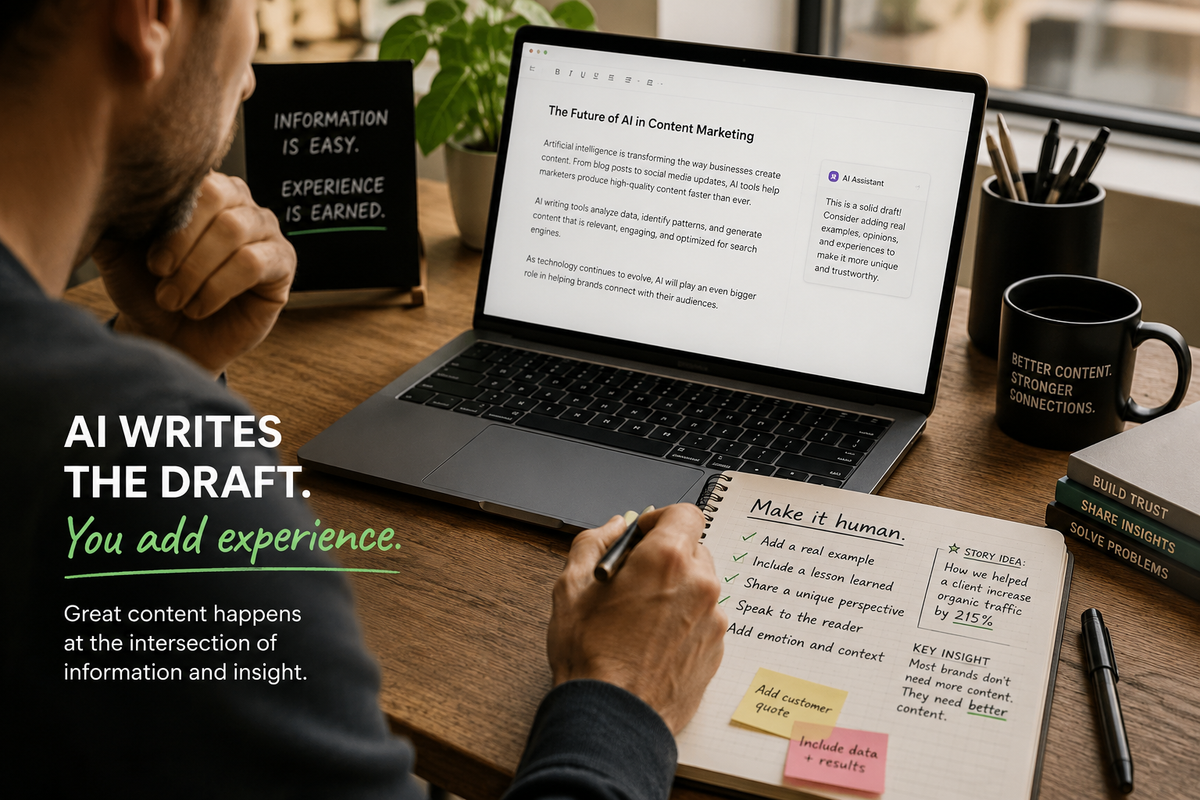
To humanize AI content, you need to turn a plain ChatGPT draft into writing that includes real experience, natural sentence flow, specific examples, clear judgment, and a voice that fits your audience. The goal is not to hide that AI helped you write. The goal is to make the final content genuinely useful, trustworthy, and clearly shaped by human expertise.
ChatGPT can create a solid first draft, but it often needs human editing before it is ready to publish. Without that editing, AI-generated content can sound generic, repetitive, overly polished, or disconnected from real reader needs.
This guide shows you how to humanize ChatGPT content step by step, when to use an AI humanizer tool, what to avoid, and how to improve AI writing for readers, SEO, and AI search visibility.
What Does It Mean to Humanize AI Content?
Humanizing AI content means improving AI-generated writing so it sounds natural, specific, useful, and shaped by real human understanding. It is not just paraphrasing sentences or replacing words with synonyms.
A humanized AI draft usually includes:
- A clear point of view
- Real-world examples
- Natural rhythm and varied sentence length
- Specific details instead of generic claims
- Helpful context for the reader
- Practical judgment from someone who understands the topic
- A tone that matches the audience
For example, a robotic ChatGPT sentence might say:
“AI-generated content can improve productivity and efficiency for marketers.”
A more human version would say:
“ChatGPT can speed up a first draft, but marketers still need to add customer examples, brand voice, and practical judgment before the content is worth publishing.”
The second version feels more useful because it explains the real-world tradeoff. That is the heart of humanizing AI writing.
Why ChatGPT Content Often Sounds Robotic
ChatGPT content often sounds robotic because it is designed to produce safe, clear, and broadly useful answers. That makes it helpful for drafting, but it can also make the writing predictable.
Most robotic AI writing has a few common patterns:
The issue is rarely grammar. ChatGPT usually writes clean sentences. The bigger issue is that the content may not feel lived, tested, or shaped by real experience.
That is why the best editing question is not, “Does this sound like AI?”
A better question is:
“Would a reader believe this was written or reviewed by someone who has actually done the work?”
How to Humanize AI Content Step by Step
The best way to humanize AI content is to improve the draft in layers: prompt quality, structure, examples, voice, experience, flow, and final editing. Do not rely on one rewrite pass to fix everything.
Here is a practical process you can use.
Step 1: Start With a Better ChatGPT Prompt
Humanizing AI content starts before the draft is written. A vague prompt usually produces vague content.
Weak prompt:
“Write an article about AI writing.”
Better prompt:
“Write an article for content marketers explaining how to improve ChatGPT drafts so they sound natural, credible, and useful. Include practical examples, SEO considerations, common mistakes, and a clear editing checklist.”
A strong prompt should include:
- Target audience
- Search intent
- Tone of voice
- Content format
- Level of expertise
- Examples to include
- Things to avoid
- Internal links or products to mention
- Brand perspective
The more context you give ChatGPT, the less generic the first draft will be.
For a deeper workflow, read this guide on how to use AI for writing.
Step 2: Add Human Experience
The fastest way to humanize ChatGPT content is to add experience the model could not know on its own.
Ask yourself:
- What have I seen happen in real projects?
- What mistake do beginners make with this topic?
- What would I warn a client or student about?
- What example proves this point?
- What detail would only an experienced person mention?
For example, instead of saying:
“AI content should be edited before publishing.”
Say:
“In most content reviews, the biggest issue is not that the AI draft is wrong. It is that the draft says the obvious and never shows the reader what to do next.”
That small shift adds judgment. It sounds more human because it reflects experience.
Step 3: Replace Generic Claims With Specific Examples
Examples are one of the strongest ways to make AI writing sound human. They help readers understand the point faster and trust the advice more.
Generic:
“Good content should connect with the reader.”
Better:
“If you are writing for students, do not just say an AI humanizer for students improves clarity. Show the difference between a stiff paragraph and a more natural version that still keeps the student’s original meaning.”
Specific examples make your content easier to quote, summarize, and remember.
This is also helpful for AI search systems because clear examples give language models more concrete information to extract.
Step 4: Rewrite for Natural Flow
AI-generated text often uses the same rhythm again and again. Human writing has more movement.
To improve flow:
- Break long paragraphs into shorter ones
- Mix short and long sentences
- Remove repeated transitions
- Read the draft out loud
- Cut phrases that sound polished but empty
- Use contractions where they fit the brand voice
- Replace filler with useful detail
For example:
Robotic:
“Furthermore, it is important to note that humanizing AI-generated content can significantly improve readability and engagement.”
Humanized:
“Humanizing AI content usually starts with readability. If the sentence sounds like it belongs in a corporate memo, rewrite it.”
The second version is clearer, more direct, and easier to trust.
Step 5: Add a Clear Point of View
ChatGPT often avoids strong opinions unless you ask for them. That can make content feel safe but forgettable.
A human editor should add judgment.
For example:
Neutral AI version:
“There are many ways to improve AI content.”
Humanized version:
“The most effective way to improve AI content is not to rewrite every sentence. It is to add the missing context: examples, audience awareness, and practical judgment.”
A point of view does not mean being aggressive. It means helping the reader understand what matters most.
Step 6: Match the Voice to the Audience
Humanized content should not sound the same for every reader. A guide for students should sound different from a guide for enterprise SEO teams.
For example:
For students:
“Use AI to clarify your ideas, but make sure the final wording still sounds like you.”
For marketers:
“Use ChatGPT to speed up drafting, then edit for brand voice, customer insight, and conversion intent.”
For SEO teams:
“Use AI to create a structured draft, then add topical depth, internal links, first-hand examples, and entity-rich context.”
Audience fit is one reason humanize AI writing tools can help, but human review still matters. A tool can improve flow and readability. A human editor decides whether the message actually fits the reader.
Step 7: Check Meaning Before You Check Style
Before making the text sound better, make sure it is still accurate.
Humanization should never:
- Change the original meaning
- Add unsupported claims
- Invent fake experience
- Make promises you cannot prove
- Hide AI use where disclosure is required
- Turn weak content into confident misinformation
This matters especially for sensitive topics like health, finance, legal advice, education, and employment. In those areas, human review is not optional.
The H.E.A.R.T. Framework for Humanizing ChatGPT Content
The H.E.A.R.T. Framework is a simple way to review and improve AI-generated writing before publishing.
It stands for:
H — Human Perspective
Human perspective means the content has a clear angle. It does not just explain the topic. It helps the reader understand what matters.
Instead of:
“AI content can be improved in many ways.”
Try:
“Most AI content does not need more words. It needs better judgment.”
That sentence gives the reader a useful lens.
E — Experience
Experience is what makes content feel credible.
You can add experience by including:
- A client scenario
- A personal workflow
- A mistake you learned from
- A before-and-after example
- A practical observation from editing AI drafts
The strongest humanized content often includes small details that AI would not naturally invent because they come from actually doing the work.
A — Authentic Voice
Authentic voice means the writing sounds like it belongs to the person or brand publishing it.
A SaaS company might sound clear and product-led. A university blog might sound educational. A solo consultant might sound more direct and personal.
The goal is not to make every sentence casual. The goal is to make the content feel consistent and believable.
R — Reader Connection
Reader connection means the article understands what the reader is worried about.
For this topic, readers may be asking:
- “Why does my ChatGPT text sound fake?”
- “Can AI-generated content rank?”
- “Will AI detectors flag my writing?”
- “How do I make AI content sound like me?”
- “Is using an AI humanizer tool enough?”
Address those concerns directly. That is how content becomes useful instead of generic.
T — Thought Leadership
Thought leadership means the article adds something beyond a summary of existing advice.
It could be a strong opinion, a practical framework, a unique process, or a clear warning.
For example:
“AI scales drafts. Humans create trust.”
That idea is simple, but it gives the reader a memorable way to understand the topic.
Humanized AI Content vs Basic AI-Generated Content
Humanized AI content is not just smoother writing. It is more useful writing.
This is why using an AI changer to human or chatgpt text humanizer can be helpful, but it should not replace editorial thinking. A tool can improve the surface. A human makes the content worth reading.
Should You Use an AI Humanizer Tool?
An AI humanizer tool can help when your ChatGPT draft is too stiff, repetitive, or difficult to read. It is most useful as an editing assistant, not as a replacement for human judgment.
A good ai humanizer can help with:
- Sentence variation
- Readability
- Natural flow
- Repetitive phrasing
- Awkward transitions
- Preserving meaning while improving tone
For example, if you want to quickly improve a draft, you can use HumanizeAI to make AI-generated text sound more natural while keeping the original meaning. It can be especially helpful when you need a cleaner first editing pass before adding your own examples, insights, and final review.
Use the tool when:
- The draft sounds robotic
- The structure is good but the wording feels stiff
- You need a faster editing pass
- You want to improve readability
- You want to compare versions before final editing
Do not rely on a tool alone when:
- The topic needs expert review
- The draft includes claims or data
- The content affects health, finance, legal, or academic decisions
- The article needs brand-specific voice
- You have not added real examples or original perspective yet
The best workflow is usually:
ChatGPT draft → AI humanizer tool → human editor → final fact-check → publish.
Does Humanizing AI Content Help With SEO?
Humanizing AI content can support SEO when it makes the page more helpful, original, and satisfying for readers. It is not a shortcut to ranking.
Search engines do not reward content just because it sounds human. They reward content that helps people.
For SEO, humanization helps because it can improve:
- Search intent alignment
- Engagement
- Readability
- First-hand experience
- Topical depth
- Internal linking opportunities
- Trust signals
- Content differentiation
For example, a generic article about AI writing may explain what AI writing is. A better article will show how to use AI responsibly, when to edit heavily, how to add examples, and what mistakes to avoid.
If your goal is AI search visibility, humanized content also helps answer engines understand and summarize your page. Clear definitions, concise answer blocks, comparison tables, FAQs, and step-by-step processes make the content easier to cite.
For more on this, read Google AI Search Optimization: The 2026 Guide to AEO and GEO and this guide to AI search visibility tools.
Is Humanizing AI Content the Same as Trying to Bypass AI Detectors?
No. Humanizing AI content should not be about trying to bypass AI detector tools. It should be about improving quality, originality, readability, and trust.
AI detectors analyze writing patterns. They may look at sentence predictability, repetition, vocabulary patterns, and other signals. But detectors are not perfect, and they do not measure whether your article is genuinely useful.
A better goal is to make the content more valuable for people.
That means adding:
- Real examples
- Clear explanations
- Personal or professional insight
- Better structure
- More natural language
- Stronger accuracy checks
If you are worried about AI detection, read this guide on whether ChatGPT can be detected and this comparison of AI vs human writing.
Common Mistakes When Humanizing ChatGPT Content
The biggest mistake is treating humanization as word replacement. Rewriting sentences is only one part of the process.
Avoid these mistakes:
Mistake 1: Only Using Synonyms
Changing “important” to “essential” does not make content human. It usually just makes the same generic idea sound slightly different.
Mistake 2: Removing All Structure
Some people think human writing should be messy. It should not. Humanized content can still be organized, scannable, and SEO-friendly.
Mistake 3: Overusing Casual Language
Not every article needs slang, jokes, or contractions. Human does not always mean informal. It means appropriate, clear, and believable.
Mistake 4: Adding Fake Personal Experience
Never invent stories, case studies, or results. If you do not have a real example, use a realistic hypothetical and label it clearly.
Mistake 5: Ignoring Accuracy
A natural-sounding article can still be wrong. Always fact-check claims, statistics, recommendations, and tool comparisons before publishing.
Mistake 6: Obsessing Over AI Detector Scores
Detector scores can be one signal, but they should not become the main goal. Reader trust matters more.
A Practical Editing Checklist to Humanize ChatGPT Content
Use this checklist before publishing any AI-assisted article.
Content Quality
- Does the article answer the main question quickly?
- Does it match the search intent?
- Does it include original examples or observations?
- Does it explain when the advice applies and when it does not?
- Does it avoid unsupported claims?
Human Voice
- Does the writing sound natural when read aloud?
- Are sentence lengths varied?
- Does the article have a clear point of view?
- Does the tone match the audience?
- Does it avoid empty phrases and generic transitions?
SEO and AI Search
- Is the main keyword used naturally?
- Are related terms included without stuffing?
- Are headings clear and question-based?
- Are there concise answer blocks?
- Are internal links placed where they help the reader?
- Are FAQs useful and directly related?
Trust
- Are claims fact-checked?
- Are examples real or clearly framed?
- Is expert review needed?
- Does the article demonstrate experience?
- Would a reader feel satisfied after reading it?
Example: Before and After Humanizing ChatGPT Text
Here is a simple example.
Basic ChatGPT Draft
“AI-generated content is useful for businesses because it can save time and improve productivity. However, it is important to edit the content so that it sounds more natural and engaging.”
Humanized Version
“ChatGPT can save a content team hours on first drafts, but the draft usually should not go live as-is. The real value comes after editing: adding customer examples, removing generic phrasing, checking accuracy, and shaping the voice so it sounds like your brand instead of a default AI answer.”
Why the Humanized Version Works Better
The second version is stronger because it:
- Names a specific user: content teams
- Explains the real workflow
- Gives concrete editing tasks
- Uses natural language
- Adds judgment
That is what humanizing AI content should do.
When Humanized AI Content Works Best
Humanized AI content works best when AI is used to speed up drafting and humans are used to improve meaning, usefulness, and trust.
It is especially useful for:
- Blog posts
- SEO briefs
- Product education pages
- Marketing content
- Student study notes
- Email drafts
- Social captions
- Knowledge base articles
- Content refreshes
It works less well when the topic requires:
- Original research
- Legal advice
- Medical advice
- Financial recommendations
- Personal experience the writer does not have
- Strong brand storytelling without human input
AI can help organize and rewrite. It cannot replace responsibility.
How HumanizeAI Fits Into the Workflow
HumanizeAI helps improve AI-generated drafts by making them clearer, more natural, and easier to read. It is useful when you already have a ChatGPT draft but the text feels stiff, generic, or overly polished.
A practical workflow looks like this:
- Use ChatGPT to create a structured first draft.
- Add your own examples, opinions, and audience context.
- Use HumanizeAI to improve natural flow and readability.
- Review the final version for accuracy, brand voice, and SEO.
- Publish only when the article genuinely helps the reader.
This keeps the process efficient without removing human judgment.
You can try the tool at HumanizeAI when you need a faster way to refine AI-generated text before final editing.
Final Thoughts: Humanize for Readers First
The best way to humanize ChatGPT content is to make the writing more useful, not just less detectable.
That means adding experience, examples, judgment, and a voice that fits the reader. AI can help you move faster, but human expertise is what makes the content worth trusting.
If you remember one thing, make it this:
AI can create a draft. A human creates the reason someone should care.
FAQs
What is the best way to humanize AI content?
The best way to humanize AI content is to add real examples, human judgment, natural sentence flow, audience-specific voice, and expert review. Do not rely only on synonym changes or basic paraphrasing.
How do I make ChatGPT content sound more human?
To make ChatGPT content sound more human, rewrite generic phrases, vary sentence length, add examples, include a clear point of view, and read the content aloud before publishing.
Can I use an AI humanizer for SEO content?
Yes, you can use an AI humanizer for SEO content, but it should support human editing rather than replace it. The final article should still be accurate, helpful, original, and aligned with search intent.
Is humanizing AI content the same as bypassing AI detectors?
No. Humanizing AI content should focus on improving quality and usefulness, not bypassing AI detectors. Better content naturally tends to include more variation, context, and human perspective.
What is the difference between AI-generated content and humanized AI content?
AI-generated content is usually a first draft created by a model. Humanized AI content is edited to include experience, natural voice, useful examples, accuracy checks, and reader-focused context.